
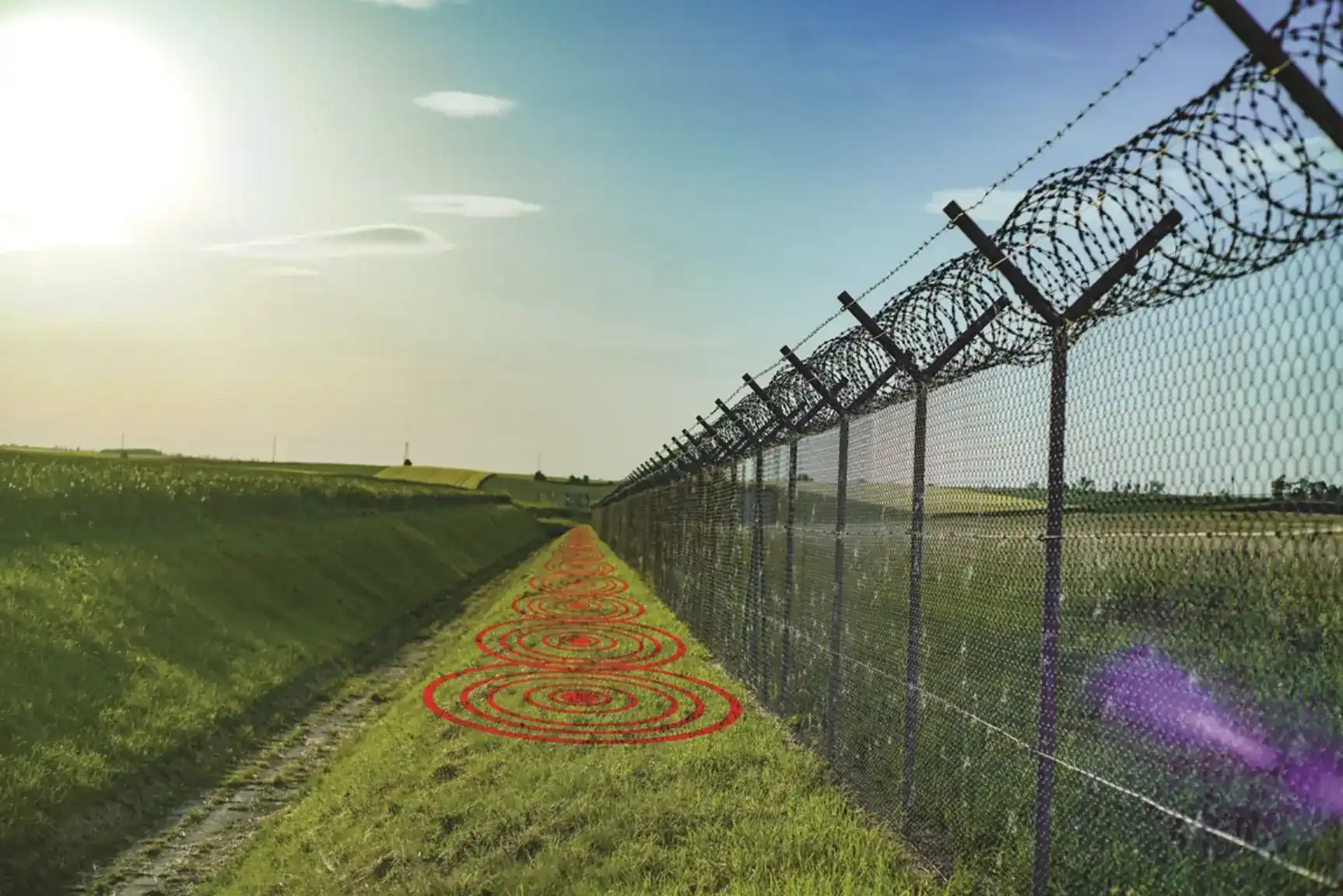
Buried perimeter intrusion detection has become popular in recent years thanks to two clear advantages: it's discreet, sometimes fully invisible, and it avoids the cost and environmental impact of building an above-ground fence.
Where Buried Perimeter Intrusion Detection Is Used
- Borders
- Oil & gas pipelines and facilities
- Military bases and other land facilities
- Airports and seaports
- Prisons
- Farms
Advantages of Underground Intrusion Detection
- Invisible, intruders can't see the system
- Nothing needs to be built above ground
- No line-of-sight requirement, unlike radar, microwave, IR, or video systems
- Fast, straightforward installation (particularly for seismic systems such as SensoGuard's)
- Simple, low-effort maintenance
Three Buried Perimeter Detection Technologies
- Seismic sensors, buried sensors detect and locate intrusions by recognizing vibrations in the ground. SensoGuard's Seismic Shield Pro is built on this technology.
- Leaky coax, a buried coax cable creates an electromagnetic volumetric detection field; a controller monitors the field for variations caused by intrusion.
- Fiber optic, a central controller transmits pulses of light through a buried fiber and analyzes reflections and disturbances to detect and locate intrusions.
We'll compare the three on performance, installation requirements, limitations, and cost.
System Topology
- Seismic buried perimeter system, sensor strings connected to a local processing unit roughly every 50m, with a central hub every 1,000m
- Fiber optic system, a central controller that can analyze a single fiber run of up to 80km
- Leaky coax system, coax cables connected to a local controller roughly every 400m (for a single cable)
Installation Considerations and Limitations
All three technologies require digging a trench, but the constraints on installation depth vary considerably:
- Seismic buried perimeter system, trench depth of 30–50cm; the precise depth isn't critical and can range anywhere from 30cm to 3m without affecting performance.
- Fiber optic system, installation depth accuracy is critical, typically no more than 20cm. Burying deeper (30cm, for example) significantly reduces performance, while shallow installation risks the cable becoming exposed over time or losing sensitivity as soil or vegetation builds up above it.
- Leaky coax cable, installation depth accuracy is critical (roughly 23cm); the system cannot be placed near metal objects such as fences or pipes, and water or snow above the cable can cause false alarms because the RF signal can't pass through it reliably.
Maintenance After Installation
Of the three, fiber optic is the most complex to repair, cable replacement is delicate and risks further mechanical damage. Leaky coax is easier to repair than fiber optic but still requires locating the fault point precisely and re-establishing correct installation depth and drainage. Seismic system components are typically replaceable quickly and easily. Leaky coax also needs periodic recalibration as soil conditions change and affect sensitivity and false-alarm rate; a seismic buried perimeter system generally does not require that recalibration.
Cost
For projects spanning a few kilometers, seismic and leaky coax systems are typically cheaper than fiber optic. Above roughly 10km, fiber optic tends to become the cheaper option. For perimeters under about 2km, a seismic system is usually the most cost-effective choice.
Performance and False Alarms
All three are buried systems that detect above-ground movement, but seismic detection tends to stand out for three reasons. First, seismic sensors can be buried anywhere from 30cm to 3m deep without a performance penalty, so added soil or a storm won't compromise detection. Leaky coax and fiber optic systems, by contrast, are far more sensitive to burial depth. Second, seismic systems are less affected by environmental change, puddles or growing vegetation can set off false alarms on leaky coax or fiber optic systems but rarely on a seismic system. Third, an adaptive seismic system with a deep-learning algorithm continuously learns its environment, revising its baseline "normal" state as conditions change (a new road, new vegetation) so it keeps distinguishing real threats from noise without manual recalibration.
Which System Is Best?
Fiber optic systems tend to be more expensive and less reliable than leaky coax or seismic systems, so the real choice is usually between leaky coax and a seismic buried system. Seismic detection is generally more reliable at avoiding false alarms and easier to install, which makes it the stronger option for most perimeters under roughly 10km.