
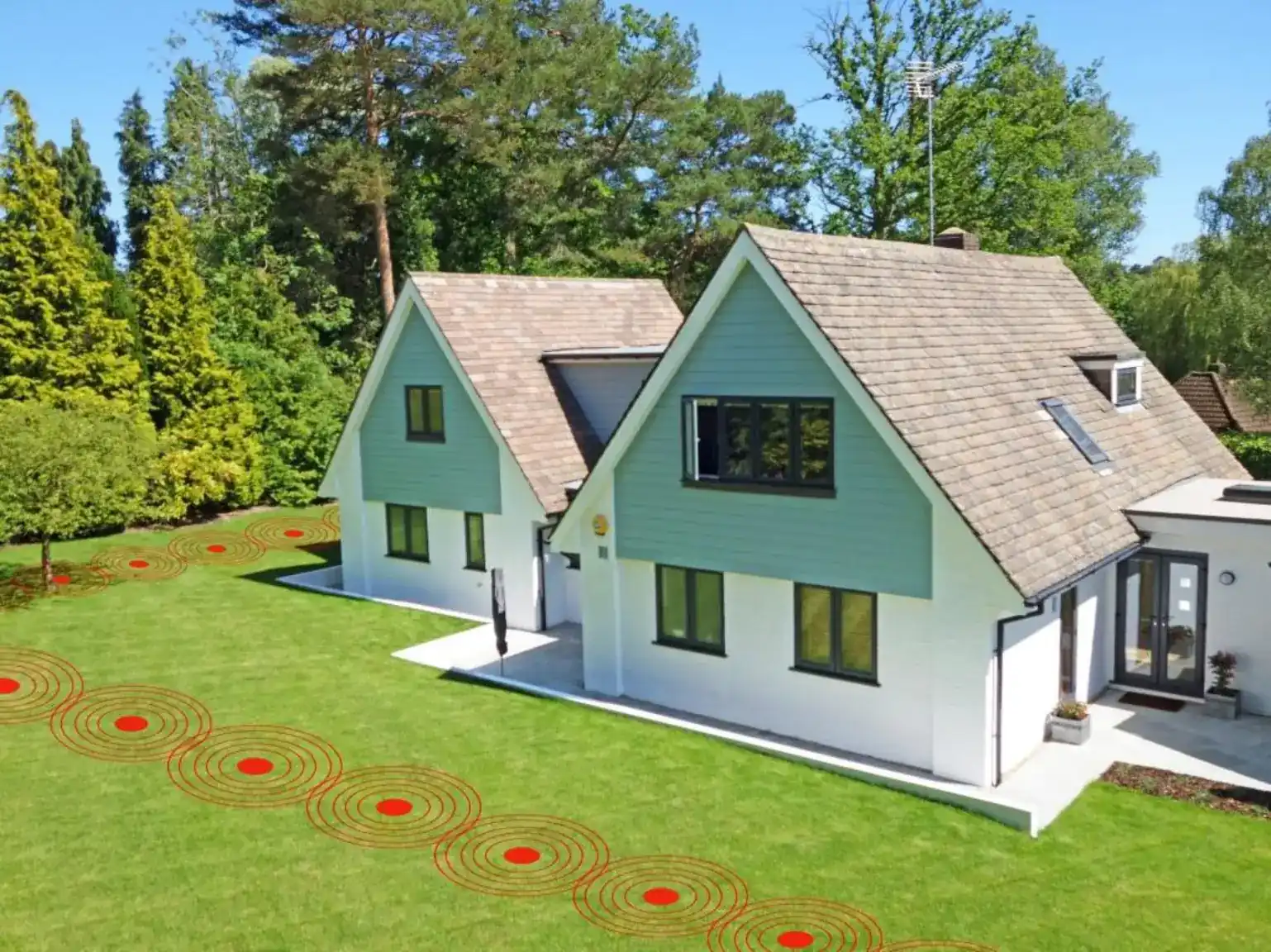
Over the years, SensoGuard has developed perimeter security systems for private homes and mansions as well as larger perimeters such as prisons, international borders, and factories. Until now, our home security solutions were all built on standalone seismic detectors. Our seismic sensors cable extends that same buried detection approach to home perimeters and other small-perimeter applications with a single continuous cable.
What Is the Seismic Sensors Cable?
The cable contains smart seismic sensors and a data-processing chip. Data collected by the sensors is processed by SensoGuard's field-proven algorithm, which detects movement above the ground, footsteps, digging, or an approaching vehicle. Because the cable is buried underground, it's invisible: intruders can't see it or know it's there.
The cable is buried around the perimeter of the home and can trigger an alarm the moment intruders start crossing the grounds. Homeowners receive a notification before anyone reaches the house, and can decide how the system should respond, sounding an alarm, activating cameras, or simply notifying a security team.
Advantages of the Seismic Sensors Cable
- Recognizes and notifies the moment intruders are on their way
- Detects intruders outside the home, before they reach the door or a window
- Invisible from ground level, intruders don't know the system is active
- Connects to any standard security alarm panel or CCTV camera via dry contact outputs
- Sustains extreme weather conditions and operates for years without additional maintenance
- Plug & play installation with central sensitivity settings via SensoGuard's PC Suite utility
- No need to plan individual sensor placement or cable lengths, unlike earlier standalone systems
Flexible Cable Layout
The buried seismic sensors cable has a flexible layout: it can be cut at any point according to the site's size and layout. After cutting, the installer connects a cable zone-unit, which powers the cable and relays alarms from the sensors to the alarm panel as a dry-contact output. Installers create zones simply by cutting the cable and connecting a zone-unit wherever needed.
Packages
| Package | Includes |
|---|---|
| 100m | 100m cable with 2 cable zone-units |
| 500m | 5×100m cable with 10 cable zone-units |
| 1km | 10×100m cable with 20 cable zone-units |
Additional cable zone-units can be purchased separately.
Technical Specifications
- DC input voltage: 12Vdc
- Outputs: dry contact output
- Sensor spacing: adjustable 5–40m (default 6.6m)
- IP rating: cable IP68, zone-unit IP67
- Operating temperature: -40°C to 85°C
For quotes and more information, contact us.
Relevant Products
- Seismic Shield, residential buried perimeter security
- Seismic Shield Pro, buried perimeter protection for critical infrastructure
- Residential protection use cases
Frequently Asked Questions
How is the seismic sensors cable different from standalone seismic sensors?
A standalone sensor like the AIO X detects from a fixed point in a 360-degree radius, while the cable provides continuous detection along its entire buried length, useful when the perimeter is better covered as one continuous line than as discrete points.
How far apart can the cable's sensors be spaced?
Sensor spacing is adjustable from 5 to 40 meters, with a default of 6.6 meters, so the layout can be tuned to the site's size and required sensitivity rather than following a fixed interval.
Can the cable be cut and split into multiple zones?
Yes. The cable can be cut at any point according to the site's layout, and a cable zone-unit is connected at each cut to power that segment and relay its alarms to the panel as a dry-contact output.
How long does the cable last, and how much maintenance does it need?
The cable is IP68-rated and the zone-units IP67, operating across a -40C to 85C range, so the system is built to sustain extreme weather and run for years without additional maintenance once installed.