
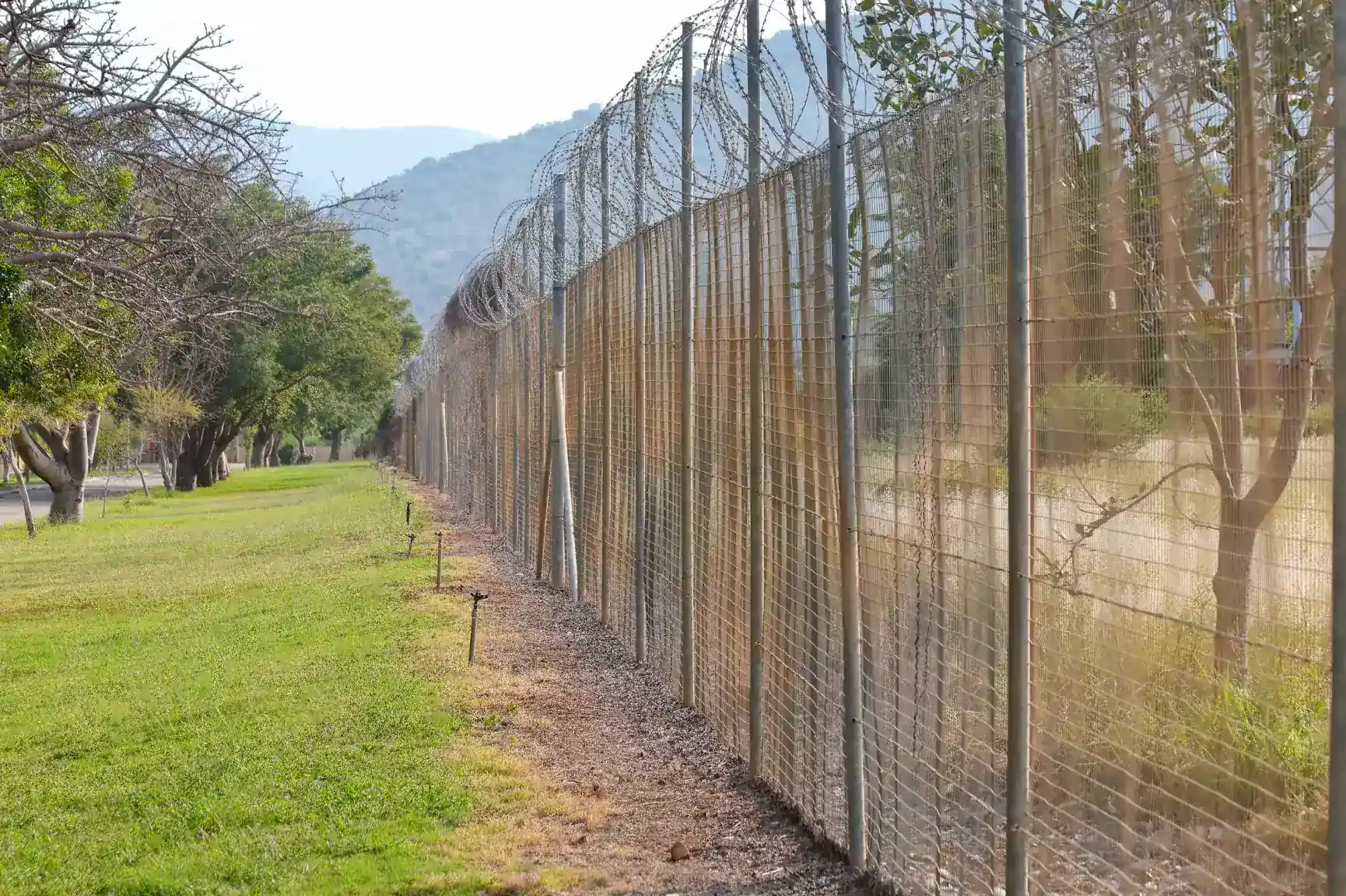
In today's security landscape, three main technologies dominate perimeter protection: underground seismic detection, fence-mounted sensors, and infrared (IR) beams. Each system offers distinct capabilities and limitations, as shown in the comparison below.
| Criteria | Underground Seismic Detection | Fence-Mounted Sensors | IR Beams |
|---|---|---|---|
| Visibility to intruders | Fully concealed, no visible hardware | Visible on the fence line | Visible posts and beam path |
| Requires an existing fence | No | Yes | No, but needs clear line of sight |
| Weather resistance | Unaffected by rain, wind, or fog | Sensitive to wind-driven fence vibration | Degraded by fog, heavy rain, or snow |
| False alarm sources | Minimal, filtered by adaptive algorithms | Wind, animals, debris hitting the fence | Birds, foliage, dust, and beam misalignment |
| Terrain adaptability | Works across open ground, slopes, and vegetation | Limited to the fence line itself | Requires straight, unobstructed sightlines |
| Defeat resistance | No wires to cut or panels to bypass | Can be bridged or climbed between sensors | Can potentially be crawled under or jumped over |
| Maintenance | Low, buried and self-contained | Moderate, tied to fence condition | Moderate, requires beam alignment checks |
Underground seismic detection is the only one of the three that requires no visible hardware and no existing fence to protect a perimeter.
For sites where concealment, all-weather reliability, and resistance to tampering matter most, underground seismic detection consistently outperforms fence-mounted sensors and IR beams. Fence-mounted sensors remain a reasonable option where a fence already exists and budget is the primary constraint, while IR beams work best as a secondary layer across short, unobstructed spans rather than as a standalone perimeter solution.